On all Active Roof boards, the digital and analog ground planes are separated by
about 30 10 ohm resistors, spaced evenly around the edge of the board. Because the
analog grounds are all connected to each other through the space frame, and the digital
grounds share common points at various places on the way back to the bulk supply,
digital return currents will tend to flow through the ground separation resistors of
the boards in order to equalize any un-matched loads. Here is a rough schematic
showing the case with two boards:

The offset that is induced between the ground planes affects the effective threshold that is
seen by the ASDBLR (for a ground offset of -30mV, a 120 DAC count threshold will appear to the
ASDBLR as 120 - 30mV / 5mV/DAC = 114 DAC counts).
One way to monitor this offset is through the high threshold noise level. The high threshold
has a very sharp noise response, the variation in which is very small compared to the
magnitude of the ground plane offsets. By taking the average 50% efficiency threshold for all
channels on a board, we can subtract out the expected noise response level and what we are left
with is the offset between the ground planes for this board (expressed in DAC counts).
To show that this is a reasonable thing to do, and also that different boards do not have
different high threshold noise levels, the following measurements were made:
For all boards on the barrel (this was in the course of sector testing), a high threshold
noise run was taken, and the offset between the ground planes was measured using a DVM. Then
the average 50% efficiency threshold for each board was plotted with the measured offset
subtracted out. The supposition is that if the high threshold noise level is a good gauge
of the ground plane offset, and if there is not a variation in the high threshold noise
level from board to board, then the plot should take the form of a sharp spike around the
'unshifted' high threshold noise level for the barrel. This number can then be used in reverse
to determine the offset voltage for any single board given its average high threshold 50% value.
Here are the results:
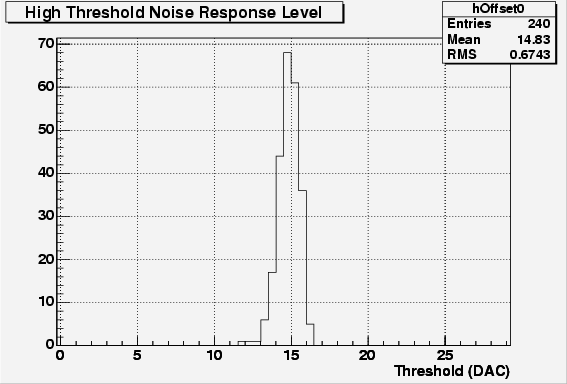
The data used for this plot is only half of that which was taken. There was an error in the
procedure that was being used to measure the offsets with the DVM that was only identified
part-way through sector testing. Here is the full set of results (the tails are taken to be
due to flaws in the procedure):
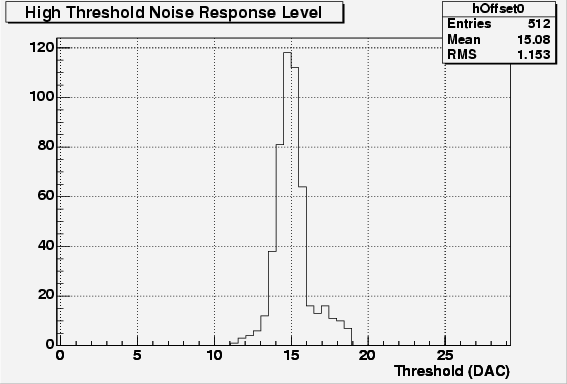
Another important factor is the level of the negative analog voltage, Vee. The zero-point of the
above distribution is strongly affected by the magnitude of this voltage. Consider the following
plot which was produced using data from the AR2BL board at phi=26 which was taken just after the
barrel was installed in the pit:

Finally, if we adjust the offset so that the value at Vee = -3.000 equals the mean of the above
distribution (which should be given more weight than data taken from a single board), we arrive
at the following equation for the 'natural' high threshold noise response:
Based on this result, all noise results that are labeled as 'Offset Corrected' have had their
ground plane offsets calculated and subtracted out by subtracting the measured 'unshifted'
value given by the formula above from that board's high threshold noise level, and shifting all
thresholds for that board according to that value. Examples of the effect this has are below:
Raw Distribution:

Offset Corrected:

Raw values:

Offset Corrected:
